
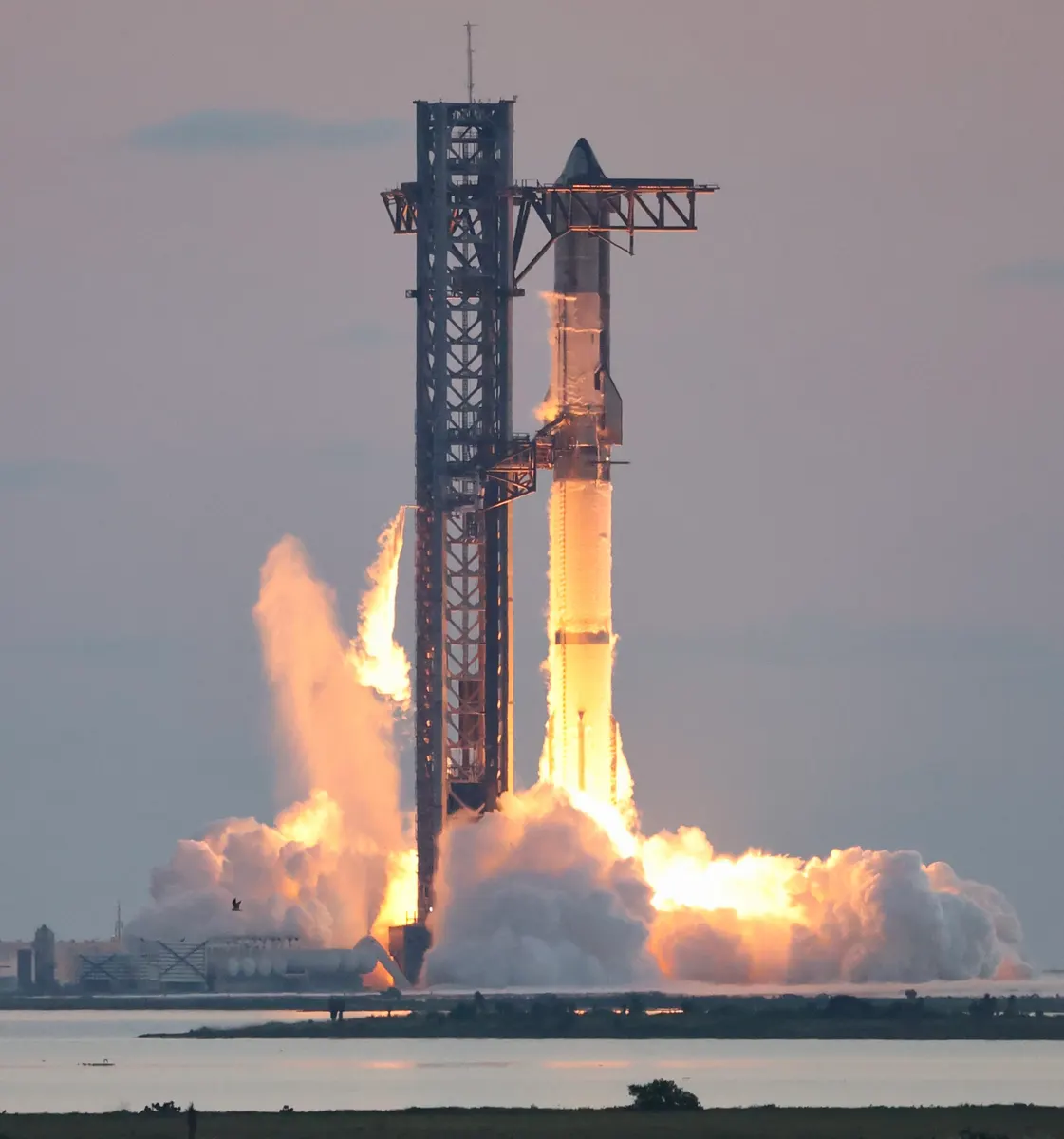
SpaceX Starship reaches Earth orbit for the first time on Flight 14
SpaceX’s Starship megrocket reached Earth orbit for the first time Monday from Starbase, Texas, on Flight 14, after controllers briefly waved off the insertion burn when an upper-stage Raptor shut down. The uncrewed ship then deployed 26 next-generation Starlink V3 satellites before SpaceX shortened the mission and planned an early Pacific deorbit.
AI-assisted · US Brief desk · Sources listed below
What happened
The uncrewed stack — a Super Heavy booster topped by the Starship upper stage — lifted off at 8:48 a.m. ET (7:48 a.m. local), Space.com and PCMag reported. After staging, one of the upper stage’s six methane-fueled Raptor engines shut down. On SpaceX’s livestream, spokesperson Dan Huot said the team would not commit to orbit, then reversed course minutes later after engineers reviewed the data and polled go for an insertion burn. A short Raptor firing put the ship into low Earth orbit — PCMag put the orbit at about 173 miles — and SpaceX confirmed “Starship is orbital.”
Why it matters
Reaching orbit is the milestone Starship needed after 13 prior suborbital test flights since 2023, Reuters noted, and underpins SpaceX’s plan to loft Starlink V3s in large batches, support NASA Artemis human landing systems, and eventually attempt rapid reuse. NASA selected a Starship-derived lander for Artemis lunar landings; orbital refueling and routine reflight remain undemonstrated. Reuters said SpaceX shares were down about 1% Monday; TechCrunch said the stock rose more than 1% early before slipping after the early mission end.
What’s next
Watch SpaceX’s post-flight timeline for the Pacific deorbit and heat-shield assessment, any schedule for the next V3 flight, and how quickly Starship can repeat orbital Starlink deployments toward the cadence Musk has publicly targeted.
More context
SpaceX’s Starship reached Earth orbit for the first time on Monday, completing the primary goal of Flight 14 from the company’s Starbase site in South Texas even after an upper-stage engine failure briefly led controllers to call off the orbital attempt.
Payload: Once in orbit, Starship deployed 26 next-generation Starlink V3 broadband satellites, the first orbital Starlink payload for the vehicle. Elon Musk wrote on X that all 26 were “operating nominally,” Reuters reported; TechCrunch said SpaceX connected to all 26. Reuters put the deployment altitude at roughly 269 kilometers (161 miles). SpaceX has said a full Starship load of V3 satellites can add far more network capacity than a Falcon 9 flight of older V2 mini satellites (TechCrunch cited a company comparison of one Starship V3 load to about 20 Falcon 9 V2-mini flights).
Mission shortened: The flight had been planned for about 10 hours and six Earth orbits before a Pacific splashdown, but SpaceX cut the mission to roughly three hours because of the engine problem, Reuters and TechCrunch reported. TechCrunch quoted SpaceX saying flight teams would “deorbit Starship safely to our pre-cleared area of the Pacific Ocean after 3 hours in orbit.” US Brief had not independently confirmed splashdown at the time of this digest.
Booster: After separating, the Super Heavy returned toward a controlled Gulf of Mexico splashdown / simulated landing. Reporting differed on how clean that return looked: TechCrunch called it the cleanest simulated landing yet for the V3 booster series, while PCMag, citing NASASpaceflight.com video, described a hard water impact after some landing-burn engines failed to light. Tower “chopstick” catches were not the plan for this flight’s ship recovery.
Uncertainty: Exact engine telemetry, the precise orbital elements, and the final re-entry/splashdown outcome were still evolving in same-day reporting. Treat mid-flight Space.com copy that still assumed a full ~10-hour profile as superseded on the mission-duration point by Reuters and TechCrunch. Booster splashdown descriptions vary by outlet.
4 listed sources
- Reuters (Joey Roulette and Steve Nesius), Sep 28, 2026: SpaceX’s Starship reaches orbit despite engine issue; deploys Starlinks; mission shortened (via KFGO)
- TechCrunch (Sean O'Kane), Sep 28, 2026: SpaceX’s Starship rocket reaches orbit for the first time
- Space.com (Mike Wall), Sep 28, 2026: SpaceX launches Starship into orbit for 1st time — Flight 14
- PCMag (Rob Pegoraro), Sep 28, 2026: After one hiccup, SpaceX reaches orbit with Starship’s 14th launch
References listed by US Brief; a source count is not a verification score.
Editorial sourcing notes
Liftoff time (8:48 a.m. ET / 7:48 a.m. local Texas), Flight 14 framing, Dan Huot go/no-go reversal, one-of-six upper-stage Raptor outage, 19-second insertion burn, ~173-mile orbit figure, and 26 V3 Starlink deployment timing follow Space.com (Mike Wall) and PCMag (Rob Pegoraro), Sep 28, 2026. Mission shortened to about three hours / early Pacific deorbit, Huot quotes, 269 km deployment altitude, share-price move (~1% down), $15B-plus development cost, and Artemis HLS role follow Reuters (Joey Roulette and Steve Nesius), Sep 28, 2026 (via KFGO reprint). TechCrunch (Sean O'Kane), Sep 28, 2026, 6:19 a.m. PT (updated), corroborates first orbit, engine-out drama, 26 Starlinks connected, V3-as-third-test framing, and SpaceX’s three-hour Pacific deorbit statement. Space.com’s earlier mid-flight text still described a ~10-hour plan; treat the early-return decision as reported later by Reuters/TechCrunch. Photos are prior Starbase / IFT-5 / 2022 NASA file images — none are from Flight 14 itself. Do not invent splashdown confirmation or booster-catch claims for this flight.
Like US Brief? You can support it with a tip.